All posts by nickrileyarchitect

Nick is a qualified Architect, with over 15 years experience. He has led projects up to the value of £50m. Nick is Board Director at Lewis and Hickey Ltd and is responsible for reporting on the Manchester office and Group Business Development. His main office base is Nottingham. Nick lives in Derby and is married with a young daughter. He enjoys playing golf (badly!) and follows Formula 1 and motorsport in general.

Multisensory Mumbai.

After spending a few days in Dubai, the second half of our recent business trip took us to Mumbai in India. We have have an office there, which has been successfully delivering architectural consultancy, Pan India, for five years now. Leaving the dry heat of Dubai and everything looking rather beige (thanks to the sand), arriving in Mumbai was an immediate assault on the senses! It was monsoon season while we were there, but luckily the weather wasn’t too bad.

Mumbai is intense, in seemingly every possible way. It is perhaps the busiest place I have ever been to (and I spend a lot of time in London). The amount of activity in any one moment is a lot to take in. Your senses are overwhelmed; sights, smells, tastes and sounds. As we drove down roads, there were people, animals and vehicles all jostling to progress on their journeys. The blend of life is amazing; from the wealthy to the poor. It is fascinating to experience, but tiring also. The roads are interesting. I’ve been on some busy roads, Rome springs to mind as one place. But in Mumbai the roads are so busy, its pretty much standstill a lot of the time. What would be three lane carriageways here are typically five-six vehicles abreast, Lorry’s, Buses, Cars, Taxi’s, Tuk Tuk’s (lots of those!) and motorbikes all moving around with no real regard for lanes. Sounding your horn is mandatory and is done so to advise other drivers that you are coming – its noisy all the time! Getting to your destination is about being patient, calm and to some extent forceful. But impact seems to be a rarity?!
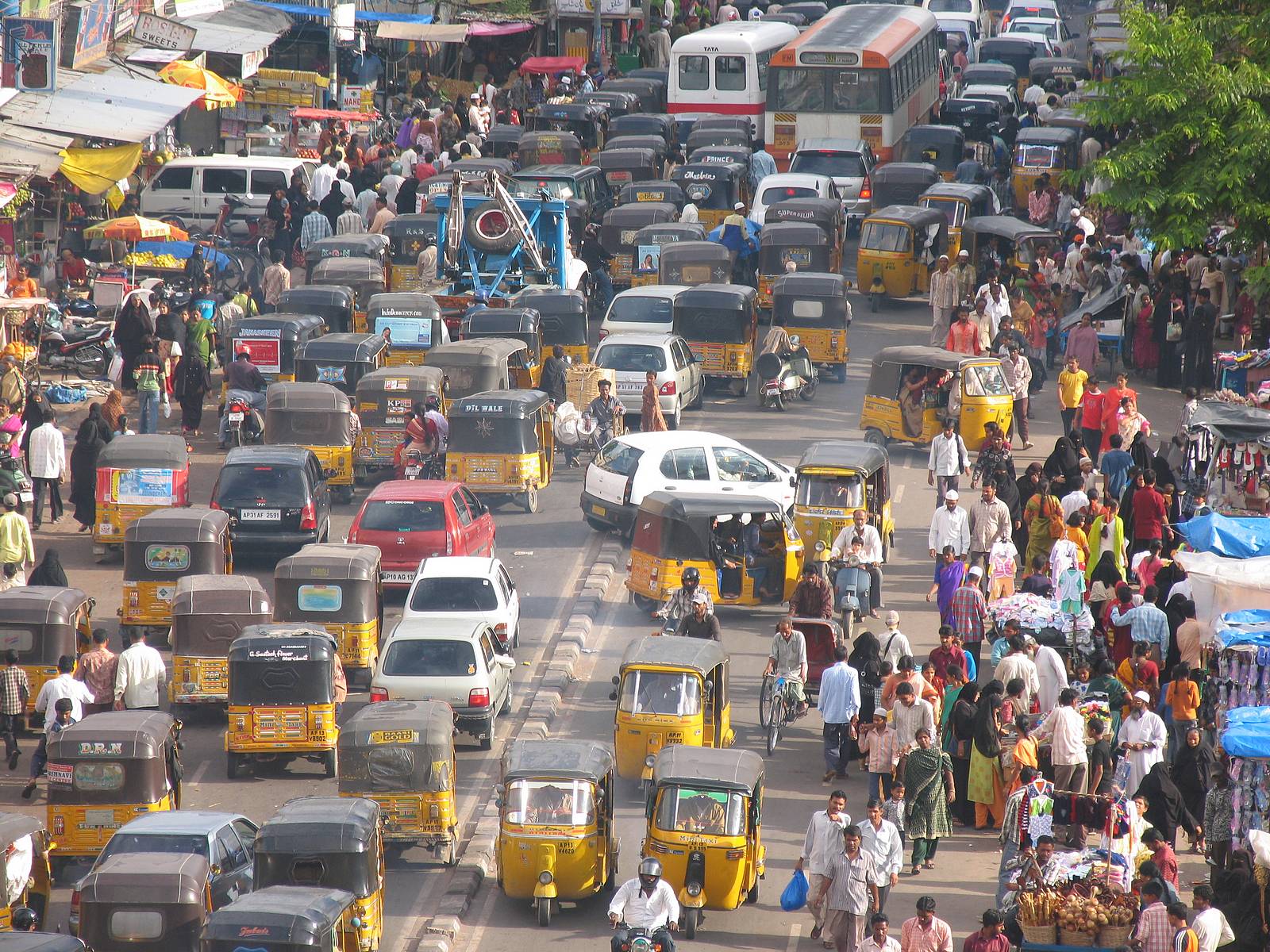
Our offices are locating in Andheri West and we stayed at Juhu Beach, both in the north west area of Mumbai. This area is also home to the Bollywood film industry.

One evening we took a drive to south Mumbai, on the way we passed the “worlds most expensive house”. I was expecting to see immense landscaped grounds and a large stately looking mansion – perhaps a bit like Buckingham Palace. No, this is a tower, its actually a 27-storey house (which is the equivalent to 60-storeys with standard floor to floor heights). It was commissioned and is owned by Mukesh Ambani, chairman of Reliance Industries. Reliance are a bit like Virgin (they have many different businesses), including a major retail company which owns the franchise rights to many global brands in India. The house is called Antilia and it has a floor area of 400,000ft2, parking for 168 cars, Nine lifts, three helipads, an Ice room (where it snows), a health spa, a 50-seater theatre and much more! Its has over 500 staff to run the place. This, as with the Burj Khalifa in Dubai, is a statement of wealth. Architecturally, I have mixed views on it. It looks better in the flesh than this photo portrays.

While in south Mumbai we visited the Leopald Cafe, made famous for two reasons; the novel Shantaram includes many references to the cafe…

“Shantaram is a 2003 novel by Gregory David Roberts, in which a convicted Australian bank robber and heroin addict who escaped from Pentridge Prison flees to India where he lives for 10 years. The novel is commended by many for its vivid portrayal of tumultuous life in Bombay.”

The cafe is also where the devastating Mumbai terrorist attacks first started in 2008. From there the terrorists went on to 10 other public buildings, killing 168 people in total and injuring a further 308 (according the official reports). The cafe experienced open gunfire and grenades. There are still visible signs on the walls of the shooting. A sobering experience. Going back to the roads (which we seemed to spend a long time on), our journey back to Juhu beach was around 10-12 miles away. It took us two and a half hours to get back. Getting around Mumbai definitely takes patience.

Architecturally, Mumbai is very interesting. There is a eclectic blend of old and new buildings everywhere and limited evidence of a true vernacular from what I saw. The amount of building activity is impressive – in some parts there are tower cranes everywhere and some impressive contemporary structures being built. The fact that there are so many people in Mumbai (12.5m and the fourth most populated city in the world) means the demand on housing is significant. There are many Slum area’s in Mumbai (we didn’t get to see these properly). People also live on the streets. But high-rise apartments are the ‘norm’ and they pack them in very closely. This photo I took shows around 4-5m gaps between circa 15-storey blocks! Directly next to these blocks is a significant high quality all-glass office building being built – the juxtaposition of such diverse buildings is unlike anything I’ve seen before.

Since being back home (and suffering a severe dose of Flu, resulting in being hospitalised to check for any tropical infections!) my friends and family have asked; Did I enjoy it? Would I go back?  “Yes” to both. My experience of Mumbai was sadly compromised by me being ill, but it is an amazing place to visit. I think two things stood out for me, which hopefully I’ve touched on in this blog. 1) Everything about the place is ‘intense’; people, movement, activity. This is fascinating, mesmerising and also tiring. 2) It has an amazing ‘diversity’; of people (again) and in its urban fabric. The spectrum of wealth is huge and it often sits together/ very close by.

We have a great team of people/ talent in Mumbai. It was great to spend some time in the office, to understand a bit more about Indian Business culture and, of course, to see Mumbai. Thank you especially to Brijesh, our Director who leads the Mumbai office, he was a great host.

The Tallest Building in the World. The Burj Khalifa

Whilst in Dubai this week, I got to see the Burj Khalifa – its practically impossible not to see it! Opened in January 2010; this is the tallest building in the world. It stands at 829.84 m (2,723 ft). That is unbelievably tall! Much talked about this week; The Shard in London is 309.6m (1,016 ft). I have blogged about this recently – click here to see it. So to try and put this into some context; the Burj Khalifa is nearly three times taller than Europe’s now tallest building.

The tower’s architecture and engineering were performed by Skidmore, Owings and Merrill of Chicago, with Adrian Smith as chief architect. The project cost was just under One Billion pounds and it is owned by Emaar Properties. Although the project nearly failed in the economic downturn commencing in 2007. The Government sought a multibillion dollar bailout from ‘neighbours’ Abu Dhabi. The tower, initially known as Burj Dubai, was then renamed at its opening the Burj Khalifa, said to honour the UAE President Khalifa bin Zayed Al Nahyan for his crucial support in realising the completion of the scheme.

The project see’s the return of the title of ‘the worlds tallest building’ to the Middle East region after the Great Pyramid of Giza held the name for four millenia – it was suppassed by Lincoln Cathedral in England in 1311. The same building also took the title in the UK from St. Paul’s in London.

The building has many impressive statistics; here are just a selection;

  • Building with most floors at 163. Previously Willis (formerly Sears) Tower – 108.
  • World’s fastest elevators: 64 km/h (40 mph) or 18 m/s. That’s over four floors per second!
  • World’s highest outdoor observation deck: 124th floor at 452m.
  • World’s highest restaurant (At.mosphere): 122nd floor at 442m.
  • Over 26,000 glass panels were used in the exterior cladding.
  • A 304 room Armani Hotel, the first of four by Armani, occupies 15 of the lower 39 floors.
  • Floors through to 108 will have 900 private residential apartments (which, according to the developer, sold out within eight hours of being on the market).
  • The building is expected to hold up to 35,000 people at any one time.
  • The building has 2,909 stairs from the ground floor to the 160th floor.
  • It takes 36 workers three to four months to clean the entire exterior façade.
  • The construction is estimated to have taken 22 million man-hours.

This is a building of epic proportion. A global statement – as it was intended. It is to be another reason to pull people from around the globe to Dubai to sustain its future.

The building sits next to the Largest Shopping Centre in the world which I blogged about earlier this week – that blog has been a big ‘hitter’ so thank you for reading. It also looks down on the Dubai Fountain set in the Burj Khalifa lake.

Thanks to our business hosts in Dubai, we were able to visit the At.mosphere bar on the 122nd floor at twilight – apparently the best time to visit in respect of the climate at that time enabling that longest views. Also seeing Dubai fall from day to night is incredible. You really can see the whole World up there – well the uninhabited island resort they have built at least! According to one source, from the top you can see ten countries: United Arab Emirates, Kuwait, Saudi Arabia, Bahrain, Iran, Pakistan, Afghanistan, Yemen, Oman, and Qatar. Also, you can also see the curvature of the earth and a distance of around 500 miles – I’m not sure whether to believe this or not, but it could be true.

There are around 100 skyscrapers in Dubai today (buildings over 180m). These range from 40 storeys to 101 storeys – and everyone of them is dwarfed by the Burj Khalifa.

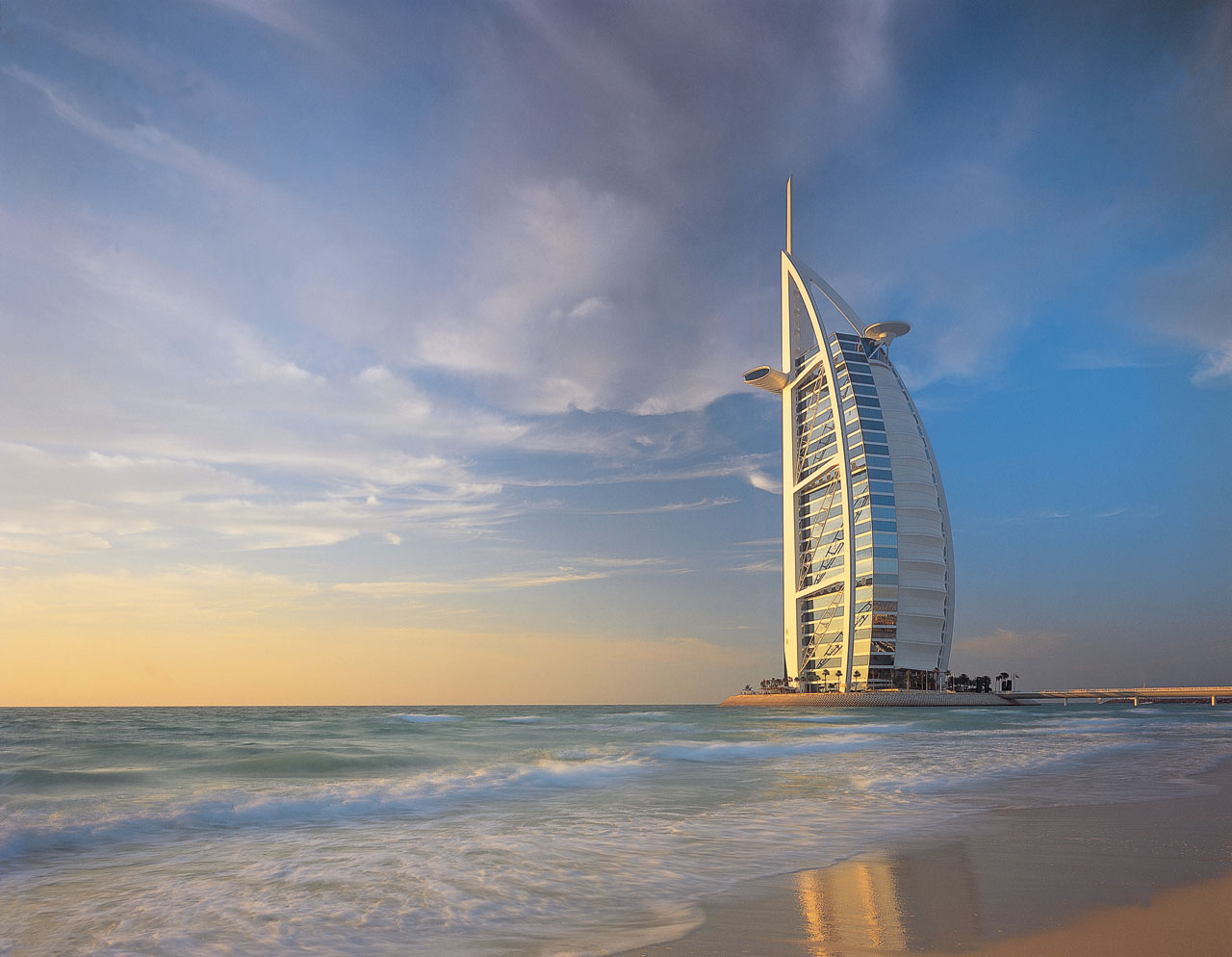
Whilst in Dubai I was keen to see the Burj Al Arab – one of few seven star hotels in the world. Its exclusive and therefore difficult to get into easily. But we took a short walk through the Jumeirah Beach hotel (this building takes no architectural credit from me!) and stood near to the Burj Al Arab. I have to say; its beauty is definitely in its form on a macro level. Its positioning on its own island is impressive. But close up, the building detailing is dare I say it; basic. Its panellised cladding and blue glass seems to dilute any feeling of quality. I’m told by our hosts in Dubai that the interiors are a little garish also. Having said that, I do still love this building, but I expected more and therefore felt a little disapointed.

To stay at the Burj Al Arab you can expect to pay nearly £20,000 a night for the highest specification suites. A ‘standard’ room is over £600 a night. I think I’d rather stay in the Armani hotel in the Burj Khalifa.

One final observation I made in Dubai is how much post-modern architecture exists there. I didn’t expect this for some reason. The diversity of architectural quality is vast – its not all good! There is no doubt that American Architects have been busy here, but I do suspect James Stirling would have liked Dubai. I enjoyed Dubai – its scale and ambition is impressive.

The world’s largest Shopping Centre. The Dubai Mall.

The Dubai Mall is the world’s largest shopping mall and forms part of the 20-billion-dollar Burj Khalifa complex, which includes a staggering 1,200 shops! It is over 12 million sq ft in total floor area (equivalent in size to more than 50 football pitches). The Mall has a total internal floor area of 5.9 million square feet (55 ha) and leasable space of 3.77 million square feet (35 ha). This is big. Really big.

The Mall sees more than 750,000 visitors every week and has become the world’s most-visited shopping and leisure destination, attracting more than 54 million visitors a year. To put this into context Times Square in New York attracts 39.2 million people a year.

The scale of this Mall and the surrounding complex is truly phenomenal. You cant really appreciate it without seeing it. But then that could be said for everything in Dubai. The centre is zoned into 10-15 ‘malls within malls’ and each area has a totally unique look and feel. The quality of this environment in terms of design, materials and overall quality is extremely high. Interestingly many UK high street brands are here; M&S, Boots, Waitrose…to name just three of our clients. Also, having worked on a number of Westfield developments in the UK over the last ten years, we understand Shopping Centres from a design and construction perspective. One of many unique and distinctive features of the Mall is the Dubai Aquarium and Discovery Centre. It has the world’s “Largest Acrylic Panel” – measuring 32.88m wide × 8.3m high × 750mm thick and weighing 245,614 kg. The panel can withstand the pressure of the 10 million litres of water used in the aquarium, but its transparency gives visitors clear views of over 33,000 marine animals on display. The aquarium tank itself is also the largest suspended aquarium in the world.

On one side of the shopping centre, externally, is the turquoise 30-acre manmade Burj Kahlifa Lake. Within the lake is the amazing Dubai Fountain. This is a choreographed fountain display, illuminated  by 6,600 lights and 25 colored projectors, it is 275 m (902 ft) long and shoots water 70m into the air – that’s over 20 storeys in building height!! The display is accompanied by and synchronised with a range of classical to contemporary Arabic and world music. It was built at a cost of £130m – for something which has no real function or tangible use other than to attract visitors. The photo below is from the top of the Burj Khalifa tower (more on that later).

All in all, this is one seriously impressive complex, inside and out. As you walk around you are constantly met with often large and magnificent features of some sort. But this is not the only Shopping centre in Dubai – far from it! There are 68 built to date! Within another, The Mall of the Emirates, is Ski Dubai. This is a 60-meter high indoor mountain (!) with 5 slopes of varying steepness and difficulty, including a 400-metre-long run, the world’s first indoor black run. Adjoining the slopes is a 3,000-square-metre Snow Park play area comprising sled and toboggan runs, an icy body slide, climbing towers, giant snowballs and an ice cave. Ski Dubai is also home to a number of penguins who come out to play several times a day. Unlike many other things in Dubai, it’s actually not the largest in the world, but no other Ski centre is located in such a hot external climate. Controlling this huge environment must consume a huge amount of energy. Sustainability doesn’t appear to be high on the agenda in Dubai, certainly compared with the UK. Unlike so many other parts of the world, fuel is in plentiful supply for everyday consumption and is cheap! But will this last.

Here is the strange thing when you consider this huge development over recent years. Dubai has a population of circa 2.2m people, that’s two and a half times the size of Birmingham. However In 1975 Dubai’s recorded population was a mere 375,000. The growth of this place is incredible. Can it sustain this growth? Where will it stop? Money certainly isn’t an object here. That said, the economic downturn did have a major impact on Dubai. But in 2012 it’s picking up again at a vast pace. As are many other places in the GCC/ UAE.

So why are these Malls so important? Why are there so many? Simple really; they are true destinations. Not just in their design and function, but in Dubai people really only socialise and enjoy leisure activity in two places; hotels and shopping centres. Nobody walks around outside – it’s too hot most of the time! Because of this I think it’s really difficult to grasp an understanding of authentic culture here. It’s so heavily Westernised. Dubai is mesmerising, fascinating…and confusing – especially when visiting from a country with so much culture and history. I have enjoyed spending some time in Dubai. In reality we got such a minuscule snapshot of the place as our time was primarily consumed in meetings with some great and talented people which, we hope to do more business with.

I remain intrigued by Dubai and wonder where it will go from here. Can it continue to grow? Can it sustain itself now? After some challenging years influenced by the global economic situation, Dubai and the wider region is picking up again.

33% of Dubai’s population are Indian. I’m spending the second half of this week visiting our offices in Mumbai to discuss current and emerging opportunities in this region with our team and some new clients. Mumbai is the antithesis of Dubai, although only three hours flight away. We’ve gone from 40 degrees dry heat to 30 degree tropical rain storms. It’s my first visit here also and already I’ve been overwhelmed by the amazing assault on your senses as soon as you arrive.

More to follow shortly on my short time in Dubai and specifically the Burj Khalifa building. Also I’ll be writing more on our Mumbai experiences too…

London Olympics 2012 – bringing out the ‘Great’ in Britain and making us shine.

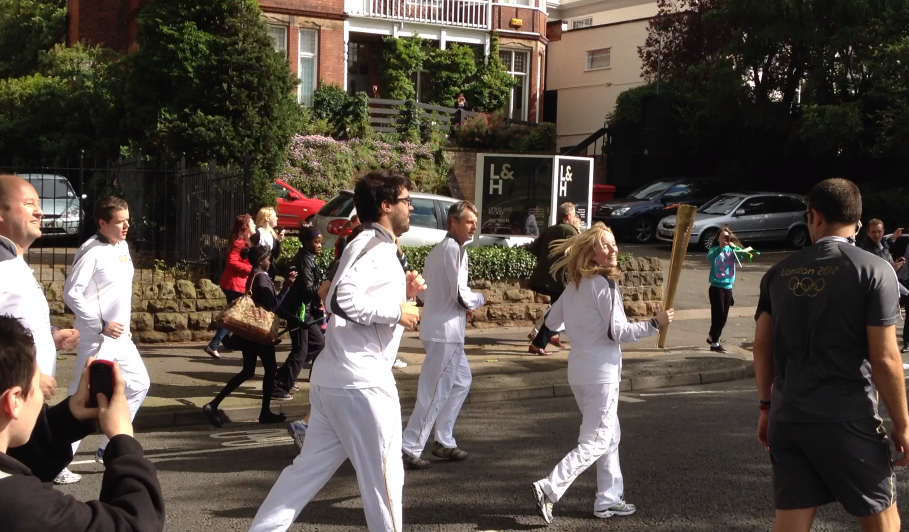
Friday saw the Olympic torch travel through both Nottingham (incl. past our office) and Derby (where I live). We went to watch the event in Derby – so we could say we took part. My daughter is two and we felt it was important for her, and us to experience this once in a lifetime event – we accept she may not remember it,  but we do have a photo of her holding a torch! I was very impressed and particularly struck with two key things…

Firstly the ‘idea’ of the torch relay (and more importantly the flame) around the UK, including celebrating a diverse range of individuals who have given something back in one way or another – “a moment to shine”. The tour means that a huge proportion of the UK population have the opportunity to take part in the build up to UK/ London hosting the Olympics. I think this ability to connect with such events on a personal level is important. The atmosphere was fantastic. I must admit, I’m not sure whether this torch relay is something unique to the UK or whether it is something other countries have done? The Second thing that struck me was the organisation behind this epic torch relay – its impressive! When you see it, you really appreciate the huge amount logistics behind this tour and it was done with superb efficiency. We got to see James Toseland, World Superbikes champion, carrying the torch.

Having been in London quite a bit recently, it is fair to say that London has a real and tangible buzz at the moment, initiated by the recent Diamond Jubilee Celebrations. Again a celebration of all things British. The Euro 2012 seemed to pull everyone together, albeit briefly! We are now in the middle of Wimbledon – again something quintessentially British! And next weekend sees the Formula One 2012 British Grand Prix at Silverstone – where F1 first started in 1950. I am looking forward to seeing the action in a Grand Stand at Luffield! Sport has a huge part to play in our day to day lives and while much of it is global in terms of coverage, it’s also very accessible to us and can promote the UK positively.

So being British seems and feels really good at the moment. The media seem to be  giving it all positive coverage too, which is good for a change! I think that in these continued times of austerity and economic uncertainty is it good to have an important economic boost and also a morale boost for Great Britain – but also celebrate our amazing diversity and history as a nation. Talking of global coverage; I am currently in Dubai and later this week will travel to our office in Mumbai, India. We are involved in a busy schedule of meetings regarding our emerging international work, more to follow on that shortly…

The Shard and the uprise of the ‘Vertical City’

I’m in London most weeks and have watched The Shard, designed by Renzo Piano, emerge at an incredible pace. Its been built in around 36 months! I really like this building. The external envelope is largely complete now and will be finished for an ‘opening’ ceremony early July (in time for the Olympics). Clearly the internal fit-out work is still underway. The physical scale of this building is phenomenal, especially when you are stood next to it. The height is clearly striking, but so too is the width of the building at its base – due to its shape. It stands on top of a railway/ underground station and rises to 310 metres (1,020 ft) providing 95 floors. Its the tallest ‘building’ in the European Union and, oddly, the ‘second’ tallest free standing structure in the UK – The Emley Moor transmitting station in West Yorkshire stands at 330m and will remain the tallest! The Shard was actually reduced in height due to Civil Aviation Requirements. Importantly, for me, The Shard will have a public viewing gallery near the top. You can see the 360 view from the top already – click here.

I think the Shard is a superb building and another strong statement for London and the UK on the global scene. No doubt it will quickly become a tourist magnet for visitors and promote London’s brand (like other significant buildings do). This reinforces the real value and importance of Architecture. I do think that tall buildings define a place and massively influence the City experience on a human level. Tall buildings give places an “exclamation mark” as Boris Johnson said when describing The ArcelorMittal Orbit at the Olympic village in Stratford. This building (?) for me is a disappointment. Proof perhaps that ‘Art’ and ‘Architecture’ can co-exist but rarely, if at all, work as one unified object? Anish Kapoor has undertaken some great commissions like Cloud Gate in Chicago and the Sky Mirror seen in Nottingham, London, Monaco, New York and Russia. Personally I don’t think Orbit has been a success. Kapoor’s frustration with realising this building was evident in the recent ‘Into Orbit’ documentary on the BBC.

I have always been fascinated by tall buildings. Often when visiting a new city its a great way to familiarise yourself with the surroundings. I remember visiting the CN Tower in Toronto back in 1997 and I think this was probably my first experience of a really tall structure. Since then I’ve been up numerous tall buildings in Europe, Australia, America and Japan. Japan was a little disappointing because of the dense brown smog! Tokyo’s latest offering is the Skytree – the tallest ‘tower’ in the world. It seems to resemble Blackpool Tower to me. The tallest ‘building’ in the world is the Burj Khalifa in Dubai. It cost US$1.5 billion to build, stands at 829.84 m (2,723 ft) and has 163 floors. I’m looking forward to seeing this when I spend a couple of days in Dubai for meetings in a couple of weeks. My personal favorite tall building in Dubai and (and perhaps the world still) is the Burj Al Arab, designed by British Architect Tom Wright. I’m looking forward to seeing this too.

Tall Buildings are Hot Property globally, despite the tough economic times. “In 2011, 88 new towers over 200 meters (656 ft.) high were built in the world – a record number, compared to the 32 new towers built in 2005. There are another 96 new towers slated for completion this year, with China being the biggest builder” according to Business Insider. The Council on Tall Building and Urban Habitat, based in Chicago, have also recently named their 2012 Award Winners for Tall Buildings.

A previous Architect colleague at Lewis and Hickey, Andrew Talbot, has recently worked on designs for Sydney’s tallest tower at Kann Finch in Australia. Andrew has been a key role model in my career development and helped me through some challenging times while I was at University – A great friend and hugely respected colleague.

So back to London – the hub for tall buildings in the UK. The history of London’s ‘tall’ buildings is relatively recent in reality. The first recorded tallest structure was the 27-metre (90 ft) White Tower, a part of the Tower of London, in 1098. St. Paul’s Cathedral (both versions of) have also been London’s tallest building(s) for many years. There have really only been a dozen or so Tall buildings between then and the now due to strict regulations being imposed in 1894 (coincidentally the year L&H was founded). The BT Tower, Centrepoint, The Natwest Tower and more recently Canary Wharf have been notable structures from the 1960’s onwards. In 2003 The Gherkin (30 St. Mary Axe/ Swiss Re) was completed and became a landmark for London – and considered a new kind of tower in design terms. Its a great building and one that I have been fortunate enough to experience inside on a number of occasions. But only in the last 10 years or so have we seen an emerging uprise of genuinely Tall buildings – and it seems set to continue…

The Shard is not alone in London, many other tall buildings are on site/ in the pipeline. These all have some great names too, there’s; The Cheese Grater (Leadenhall Street), The Walkie Talkie (Fenchurch Street), The Pinnacle (Bishopsgate Tower) to name just a few. Full details of London’s existing and proposed tall buildings can be seen here.

Outside of London, I’ve talked before about the Beetham Tower in Manchester, another city I spend a lot of time in! Driving into Manchester, from seemingly every direction, The Beetham/ Hilton tower is always central to your view – in Manchester it is a real exclamation mark. I think it gives prominence and importance to the City.

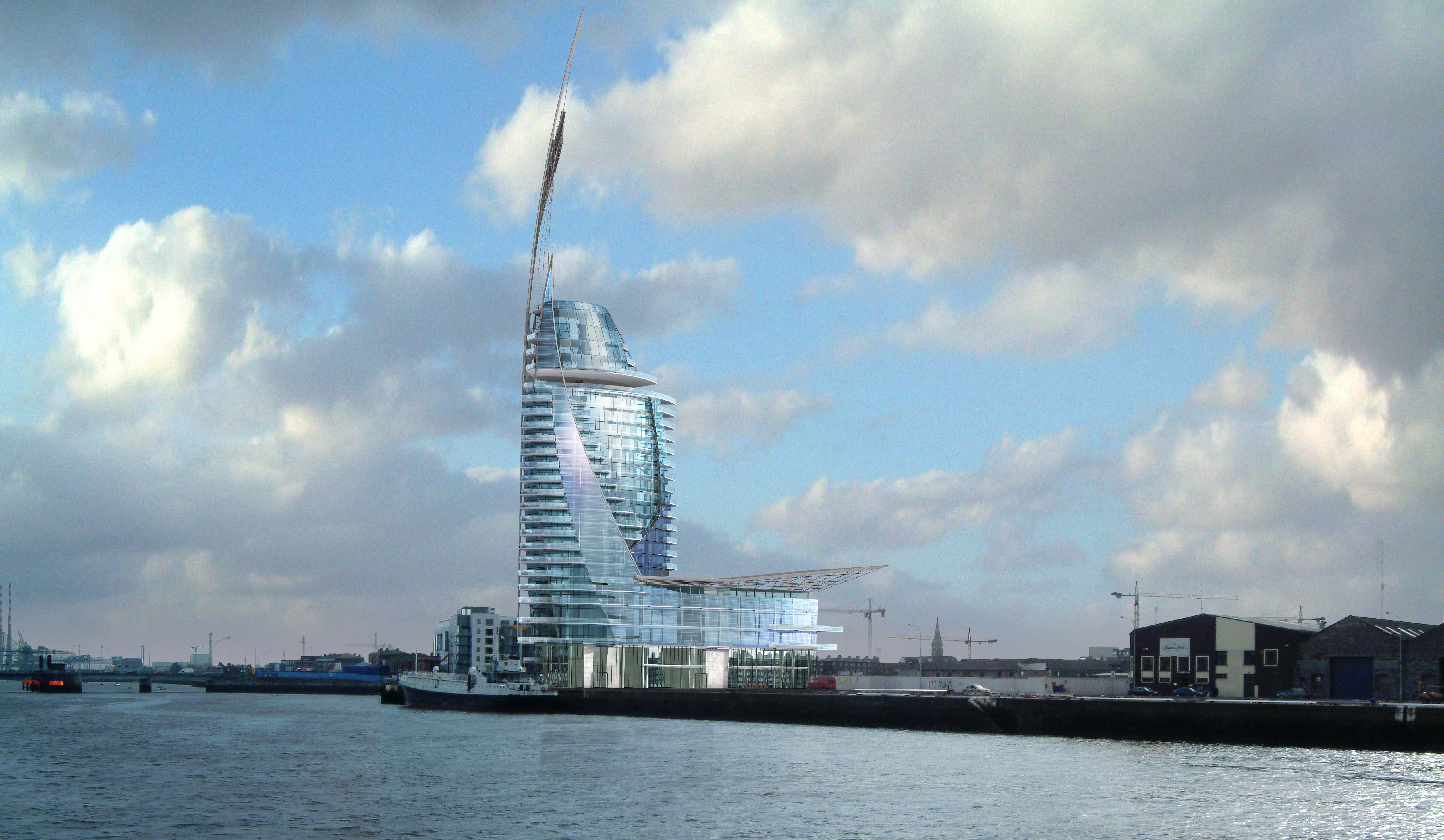
Lewis and Hickey have experience in Tall Buildings. We’ve delivered several schemes of circa 20 storeys and have just submitted a Planning Application for a 16 storey scheme in the South. We have also designed a tower in Dublin a few years ago – and the Client was U2! This is the scheme…So what can I conclude from my fascination in Tall Buildings and all the activity with these structures at present? Well, it would appear that the ‘uprise of the Vertical city’ is set to become more and more common, albeit in major global cities at present. But perhaps its only a matter of time before regional cities in the UK aspire towards making a statement also? I think this would be good. The Challenge is to design something different/ unique every time!…and also ensure that people can access the top to admire the great views.

Communicating new ideas – from the next generation

It seems a while ago now since I was at University, working towards my life-long goal of becoming an Architect. Its a long old road which requires a huge amount of focus and dedication all the way. You’ve got to really want it. Studying Architecture part-time (whilst working full-time in practice) is perhaps the toughest route, in my view. This is how I qualified and we have a number of staff who are taking this route as well.

One young man who has recently been through the sleepless nights and endless weekends of work is Matthew Bennett in our Nottingham office. Matthew has been with us for over six years and I remember being asked by then our MD, Clive Welham, to meet him when he came for Interview. Clive said “Nick, you’ve got to come and meet this lad, he’s an even younger version of you!” Matt was nervous, but it was easy to see he had something about him and would fit in well. I’m pleased to say that Matt is now a key member of staff in our Nottingham team and well respected by his colleagues. He is developing into a good young Architect and has just completed his RIBA Part I, BA (Hons) degree at the University of Lincoln.

Matt’s final project is an interesting one from a number of perspectives and I wanted to share part of it – in recognition of his efforts on this and also his work at L&H.

Here’s Matt’s story about his project…

“The project; ‘Brick Reinvented’, began as a simple study of brick in general looking at the history of brickwork, physical properties, manufacturing, current uses and current possibilities in design and form. The study was demonstrated in a celebratory manor and whilst my personal view of brick was a positive one, it was apparent that there were some fundamental floors in the continuing use of ‘brick’ as we know it. One was from a use/ design perspective, bricks are so desirable mainly because durability/ flexibility/ cost. This had led to it being used in a fairly ‘functional’ way, particularly in the construction of domestic housing – with seemingly little/ no real imagination in terms of design.”

“The other, and arguably the most important was the question of ‘sustainability’. Through my research I discovered that most of the 2.3 trillion bricks produced in the world each year are manufactured in India and China in coal fired kilns and that firing a coal-fired kiln up to 2,000 degrees emits 0.5kg of carbon dioxide per brick. Additionally In this country co2 emissions from brick manufacturing are higher than ever and in response to this the European Union is looking at carbon taxing brick under the classification of heavy clay materials. This could mean that 90% of the co2 produced from the industry would be taxable, pushing costs through the roof and forcing a potential end of brick production in this country.”

“These two floors made me question its suitability as a material for the modern built environment and led me to seek for an alternative. There don’t appear to be any bio-bricks on the market yet, but in its research phases. This is an engineered module made predominantly of sand through a chemical saturation process called microbial-induced calcite precipitation.”

“I looked for a site where I could design a building that would promote the use of this ‘new brick’ as an improvement to the current and somewhat dated brick we all know. Nottingham seemed a good City, with its vast array of interesting historic brick buildings, I could design a modern interpretation of a masonry built mixed use building. The site was picked due to its prominence when entering the city centre from the south. Currently siting industrial sheds, I felt that the site was underutilized as a potential ‘gateway’ into Nottingham and that it could benefit from a medium rise high quality building.”

“The building’s use is for a Research & Education Centre, for Innovation in Construction Materials. The idea being that this would continue to promote advancements and use of new materials. The Centre consists of a public café and gallery with research laboratories, design studio’s, workshop and testing facility. The testing facility incorporates mounting panels that can be moved between the internal and external testing spaces allowing materials to be tested for various properties internally such as durability, impact, thermal and can then be moved outside for weather testing…

Whilst this summary from Matt gives a mere flavour of his thinking/ design for this building, I think Matt has demonstrated an ability to think outside the box and be analytical in his design progression.

However, I think Matt’s strongest skill, both at University and in his work, is his ability to produce high-quality drawings which communicate his designs. Effective Communication – in lots of different ways – is after all perhaps the most important part of being an Architect. I certainly think it is.

Well done Matt.

Doing business in India

We established an office in Mumbai, India around five years ago. In that time we have developed a diverse port-folio of work across the country. This includes extensive design and delivery of Retail work (our company heritage) for some major Indian and International brands. We have also worked on a lot of new-build development projects to provide Offices, Hotels, Mixed-use, Retail/ Leisure centres and Residential buildings. A lot of this work has included concept design work from our UK offices, especially London.

Mumbai, formerly known as Bombay, is the commercial and entertainment capital of India. It is also the world’s top 10 centres of commerce in terms of global financial flow, Mumbai accounts for slightly more than 6% of India’s economy contributing 10% of factory employment, 40% of income tax collections, 60% of customs duty collections, 20% of central excise tax collections, 40% of foreign trade and rupees 40,000 crore (US $10 billion) in corporate taxes to the Indian economy. Headquarters of a number of Indian financial institutions such as the Bombay Stock Exchange, Reserve Bank of India, National Stock Exchange, the Mint, as well as numerous Indian companies such as the Tata Group, Essel Group and Reliance Industries are located in Mumbai.

We are keen to explore opportunities to expand upon our UK connections with India. We recognise that a lot of UK/ EU companies are now either working in India already or considering entering it’s attractive emerging economy. If you are looking at development/ retail expansion opportunities in the region; we are keen to talk to you – either in the UK or India. Tim Hall (our London office MD) maintains very close links with our India team and our Mumbai team is led by Brijesh Kanabar.

Theo Pywowarczuk and I are heading over to our Mumbai office for a week shortly to assess our operations on the ground and to explore further opportunities to grow our contacts/ work out there. We are also exploring a number of potential opportunities which may also see us widen our regional coverage beyond India.

From numerous recent discussions on India, we understand that a number of UK Further and Higher Education Institutes are expanding into this region. Given our growing port-folio of UK University clients, we again see this as an opportunity to work with UK based clients in India.

I will be sharing more information about our projects in India in the coming weeks and also posting some blogs on our travels – so watch this space for more. In the meantime, please don’t hesitate to contact us if you are actively working in India and believe there could be tangible benefit in us talking in more detail.

Our University client base continues to grow…

We are delighted to have recently secured another major student living development in the business, this time through our Manchester office…

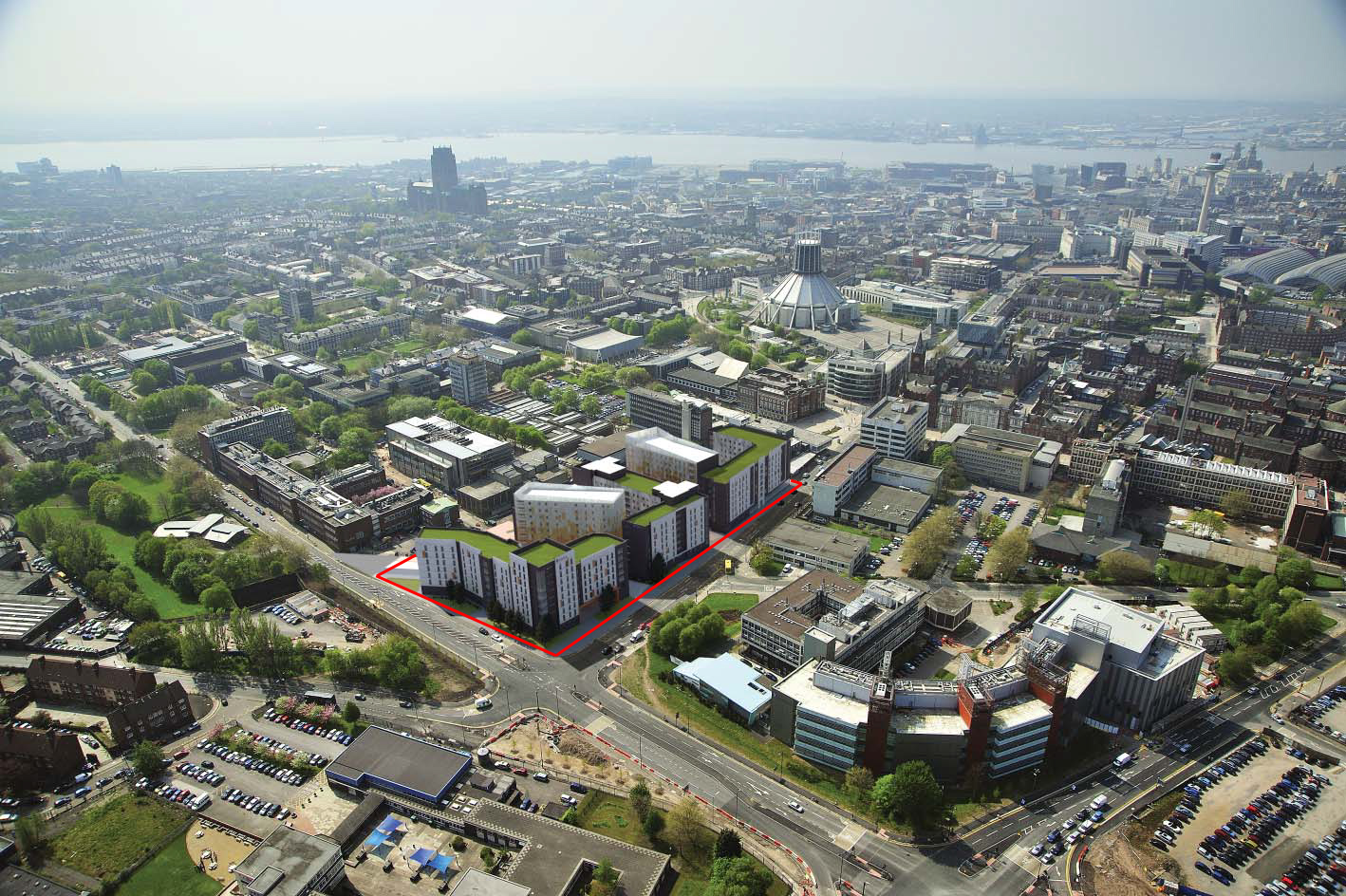
The project will provide over 1200-bedrooms, on-campus for the University of Liverpool. We were invited to partner with long-term client Ocon Construction to bid via the OJEU (Office Journal of the European Union) process for the scheme. We started the bid in December last year and went through a comprehensive two-stage bid process, taking our designs for the project to RIBA Stage C/D. Since winning the bid, we have already submitted the proposals for Planning Permission.

The University of Liverpool is a teaching and research university in the city of Liverpool, England. It is a member of the Russell Group of large research-intensive universities and the N8 Group for research collaboration. Founded in 1881 (as a university college), it is also one of the six original “red brick” civic universities. The university has produced nine Nobel Prize winners and offers more than 230 first degree courses across 103 subjects. It has an annual turnover of £340 million, including £123 million for research. (source: Wikipedia).

We were selected by Ocon, who are recognised sector leaders in constructing student accommodation, because of our diversity of experience in the sector – they know that we can ‘add value’ based on our ability to not only design, but also deliver successful schemes. The key to our success is in balancing good, informed design with commercial understanding. Making these transactions work is about meeting (and exceeding!) the clients aspirations and requirements, whilst also ensuring it can be built on time/ budget and achieve a good lifecycle.

While the economic downturn/ funding availability has reduced the level of off-campus private development, we have seen the Universities increase their concentration in this area. Why? Well if students are paying up to £9000 a year in fees, they will expect not only outstanding academic standards in their courses and facilities, but also accommodation which is modern, well situated and includes all the latest facilities. I think its fair to say that  accommodation does make up an important part of a students decision when choosing where to study – and because of that; the bar is being continually raised in this hugely competitive market.

Universities remain a strong focus for us as a business – they are hugely interesting clients to work with and offer some excellent design opportunities.

The Starbucks name game.

Would you walk into Starbucks and say ‘Morning, I’d like a Flat White and for you to announce to the whole coffee shop my name please‘? – Or, does this sound a little odd?

Well take a visit to Starbucks anywhere in the UK now and you’ll be asked “What drink would you like?” followed by “…and what is your (first) name please?” When your drink is ready, your name is then shouted out – even though you are likely to be stood less than a metre away. Starbucks are doing this to make the customer experience more personal – is this a step too far for the American thinking firm?

“Have you noticed how everything seems a little impersonal nowadays?”, its website asks wistfully. “We’ve all become user names, reference numbers and IP addresses…From now on, we won’t refer to you as a ‘latte’ or a ‘mocha’, but instead as your folks intended: by your name” the coffee chain claims.

I have to question this. Being honest; I don’t really like every stranger in the coffee shop knowing my name. I don’t know them and will more than likely never meet them again. I suspect for most people this is actually compromising the ‘customer experience’. The barista’s seem uncomfortable asking your name and most customers either act surprised or uncomfortable having to provide their name back. The whole ‘experience’ is a little strange and doesn’t make it feel personal in a positive way.

I wonder whether this Starbucks initiative is actually more about getting them in the news and people talking about this subject (like me!) in an attempt to raise their profile, rather than actually focussing on the customer. This could be clever marketing, but are they boosting their coffee sales from this? I strongly suspect not.

My name, next time I visit Starbucks, will be ‘Costa’! 🙂

The future of Student Living investment and development.

I attended a property and investment conference yesterday at the Congress Centre in central London. The title/ focus of the conference was ‘The globalisation of Student Housing and the Future Investment market‘. As usual it was a well attended event – probably 350+, with senior representatives from UPP, Liberty Living, The Mansion Group, Campus Living Villages, Bouygues, Opal Group, Knightsbridge, Watkins Jones…to name just some! The student living property market has remained buoyant through the recession and investment/ development has continued, albeit at a much lesser level than at its peak in 2006. As well as continued development of new buildings in 2012, the property transaction market is active and large deals continue across London and the regions as new entrants seek attractive investment returns on assets and existing players restructure their property port-folios/ funding/ debt facilities.

Funding remains an obstacle in the sector, the banks are obviously risk adverse, but perhaps need to change their thinking about only backing the ‘The Times Top 20‘ – these are high profile institutes with a strong supply of purpose built housing! Are these really the best locations/ schemes to fund? The need in the market is the top 20-50+ ranked universities. Robust schemes in the right location, with the right design and realistic cost models can be achieved – and should be funded. Clearly there is much more I could say about funding, but that’s not my focus. What I would say is that both private and university deals are happening in the sector. We are involved in a number of significant transactions at present – one of which is in excess of £100m. We have also just secured a project with the University of Liverpool for circa £50m. There are many more we are working on at various stages and our experience extends to every one of our UK offices now.

Interestingly the view on the impact of student fee increases is pretty consistent from all quarters (universities, developers, operators, agents, investors, funding organisations); it wont have a significant or detrimental impact on the continued need for Student Housing.

‘Student Experience’ is a hot topic this year – the bar is being raised in the quality of accommodation from both the building fabric externally and internally, but also in how facilities are managed/ operated. Universities need to align their housing offer with the academic offer – and with higher fees comes increased expectation of quality throughout university life. New design ideas continue to emerge and this has been a big focus for us in demonstrating to clients that we continue to lead the sector in design. We have delivered in excess of 10,000 bedrooms in the last 6-8 years and we have at least 5000+ beds in design development at present.

A big theme of yesterday’s conference was on future ‘globalisation’ of student living – the UK is No. 1 globally, in terms of volume, in property and investment of purpose built student living – both on and off campus. UK universities are expanding and investing globally now, for lots of reasons. With that comes increasing opportunities to take our successful UK experience in student living to European countries, Australia, America, China, India and many others. Jones Lang LaSalle have recently published a feature on this which can be see here.

Yesterday’s conference has once again been hugely positive and useful for me and our business – we are an established and recognised architecture firm in the sector with a huge diversity of experience now. We have some excellent long-term clients in the sector, with whom we are proud to be associated with. I now have a number of meetings to progress in the coming weeks, with potential new clients, to continue to fly our flag and tell people how we can genuinely ‘add value’ to development projects through our experience and way of working.