All posts by nickrileyarchitect

Nick is a qualified Architect, with over 15 years experience. He has led projects up to the value of £50m. Nick is Board Director at Lewis and Hickey Ltd and is responsible for reporting on the Manchester office and Group Business Development. His main office base is Nottingham. Nick lives in Derby and is married with a young daughter. He enjoys playing golf (badly!) and follows Formula 1 and motorsport in general.

The Ashes and Trent Bridge

As British sport appears to be booming with success, this weeks attention turns to Cricket with the first Test of The Ashes at Trent Bridge. This is an important event for Nottingham to showcase the City to a global audience.

On Monday night this week I was a guest of Couch Perry Wilkes and Interserve Construction at a Black Tie Investec dinner at Trent Bridge. This was to launch The Ashes week. It was a great dinner in a stunning location. Our hosts/ entertainers for the evening were David “Bumble” Lloyd, Jonathan “Agers” Agnew and ex-Aussie player Glenn McGrath. These guys were on good form, Bumble was positively hilarious! I’m back there again today watching the second day of action as a guest of Freeth Cartwright in the Hound Road upper tier.

Glenn McGrathThe Ashes series dates back to 1882 when England played Australia at the Oval – and lost. The British Sporting Times newspaper published a mock obituary stating that “English cricket had died, and that the body will be cremated and the ashes taken to Australia”. The following series between England and Australia was then dubbed “the quest to regain the ashes”. During this series a group of Melbourne women presented a Terracotta urn to England captain Ivo Bligh, the contents of which were reputed to be the ashes of a bail from the wickets. The series is now the one of the most popular and celebrated in the sport and the urn has become the ‘prize’. However, these are always replicas of some form. The original urn, which was gifted to the MCC by Bligh’s widow, lives at the Marylebone Cricket Club Museum at Lord’s. England are the current holders of The Ashes and look set to retain the title this year (hopefully!). However Australia have won it the most times (31), but a series win for England this year will put them level.

Trent Bridge pre-dates The Ashes as it was first used as a cricket ground in the 1830’s. The first test match hosted there was in 1899, between England and Australia. The ground was officially opened in 1841 by William Clarke, the captain of the All England Cricket Team and husband of the proprietress of the (world famous) Trent Bridge Inn. There is a stand at the ground in his name now. Trent Bridge has changed a lot over the years, especially recently with a number of new stands and floodlights. However the original Pavilion building, dating back to 1889, remains largely the same as it was and regarded as a trademark to the sport. Today the ground can seat 17,100 people and its most recent addition is Europe’s largest outdoor video screen which partly masks the County Councils office block built in the 1960’s and cost £1.8m.

Trent BridgeTrent Bridge is a great historic feature of Nottingham and has evolved well over the years. It’s great to see The Ashes here again and its good for Nottingham’s economy.

Fingers crossed England will win this first Test and the whole Series in due course. Cricket certainly isn’t dead today.

The grass is greener at St. George’s Park

I have recently been on a tour of the Football Association’s new St. George’s Park National Football Centre in Staffordshire. Its an impressive multi-use facility which has taken years to realise.

The FA historically have used Lilleshall Hall in Shropshire as their England team training facility, a place steeped in history as the 1966 World Cup winning England team trained there. It became a formal FA School of Excellence in 1984 and was closed in 1999.

St. George’s Park was formally part of the Needwood Estate owned by the Berkeley Family, it was later owned by the Crown before the Bass family owned in from the 1850’s up until the 1950’s. Forte Hotels put plans in place to redevelop the site into a hotel complex, but these were shelved after Planning had been granted. The FA acquired the 330-acre site in 2001 for £2m. Proposals were developed in the early 2000’s, but funding issues, related to the Wembley Stadium development, stalled the project for a number of years. In 2008 the decision was taken to build the development and Newcastle based Architects Redbox design were appointed. The £110m project was completed in July 2012 and officially opened by the Duke and Duchess of Cambridge in October that year.

The building complex is rather secluded as you enter the main entrance off the road. The winding approach drive, flanked by football pitches named after England legends, reveals a dramatic entrance to the Hilton hotel(s) on the site. The FA’s football centre is located behind the hotel, which doesn’t feel altogether natural given that is the main function of the whole site. I guess a layering of public/ private use on the site informed this back to front arrangement.

AERIALThe impressive 4*+ Hilton hotel provides for your every leisure/ business need. It includes extensive corporate conferencing facilities & business centre, A Spa/ Leisure centre, bars, restaurants, private dining, atrium coffee lounges and a range of luxury bedroom formats. Subtly linked to the luxury Hilton there is also a Hampton by Hilton hotel wing which offers mid-range accommodation. Apparently this is the only location in the UK where two Hilton hotel brands operate within the same building. The Architecture is good quality and it does feel quite special.

DSC_0138bThe FA centre, whilst fairly simple and understated externally, is seriously impressive internally. The main reception is within a three storey atrium which is decorated with manikins on the walls with multicolored football shirts on (click here to see it). There are a wide range of changing facilities on the ground floor which include the “Elite” rooms, used by the England squad. These are actually not as lavish as I’d have anticipated, but do have ice baths – and lots of vanity mirrors/ worktops!

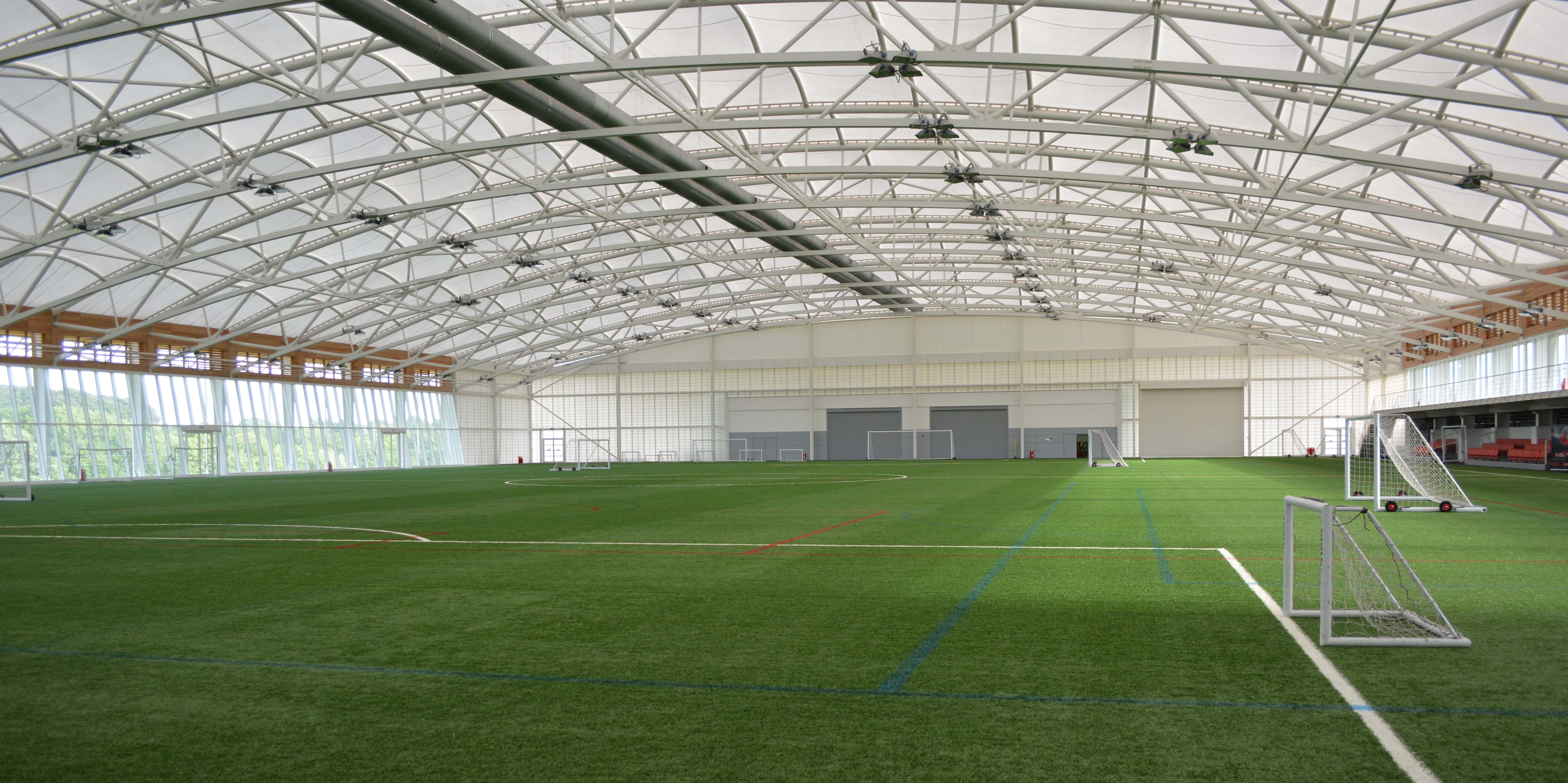
At either end of the building are substantial sports halls. The walls are generally clad with Kalwall, a translucent material which allows lots of natural daylight through. North facing roof lights also maximise natural light. One of halls is used for Futsal and has a sprung floor, coated with a blue rubberised material. This gives the large space amazing acoustics. In the second larger hall is a full sized football pitch made of artificial ‘3G’ grass. The is naturally ventilated and has a glazed wall down one side with views out over the woodland. Despite the fact you are covered from the elements, this does feel rather like an external space/ pitch. Alongside the pitch is a running track. This has blown ventilation tubes for cooling and to simulate an external environment. It also has HD cameras and speed traps to record, in minute detail, the footballers training/ development, especially for injury problems.

DSC_0110bExternally are a wide range of immaculately groomed and lush pitches. the one situated right next to the building is a full scale exact replica of the Wembley stadium pitch, including all dimensions, gradients and the grass of course.

The final central element of the FA centre is the cutting edge sports fitness, development and rehabilitation centre. This is operated by Spire Perform and you can see a video of these facilities here. It has some incredible equipment for sports development and injury rehabilitation which includes;

  • Full Hydrotherapy centre which includes; a full size swimming pool with an automatic movable floor, an underwater treadmill (again with monitoring HD cameras) and a hot & cold hydro pool.
  • An Altitude chamber
  • An Anti-gravity treadmill (Mo Farah uses one of these)
  • A full gymnasium suite. This is long and narrow in plan form and has extensive glazed walls looking out over the football pitches. This is to help players focus physiologically on ‘where they want to be’.

All in all, St. George’s Park is a hugely impressive complex. Surely our England squad are fully equipped with every possible aspect of support and training to help us return to a winning 1966 form? The expectations from England for Brazil 2014 are perhaps greater than ever now!

To see more of SGP, its well worth booking a tour – or take a look at this extensive 360 virtual tour here.

The F1 Pirelli Tyre shambles!

I’m an F1 fan, I have been since I was a child. The sport has changed quite a lot over the years, but recently the world of F1 seems to be more consumed in technical/ political controversy, rather than actual racing!

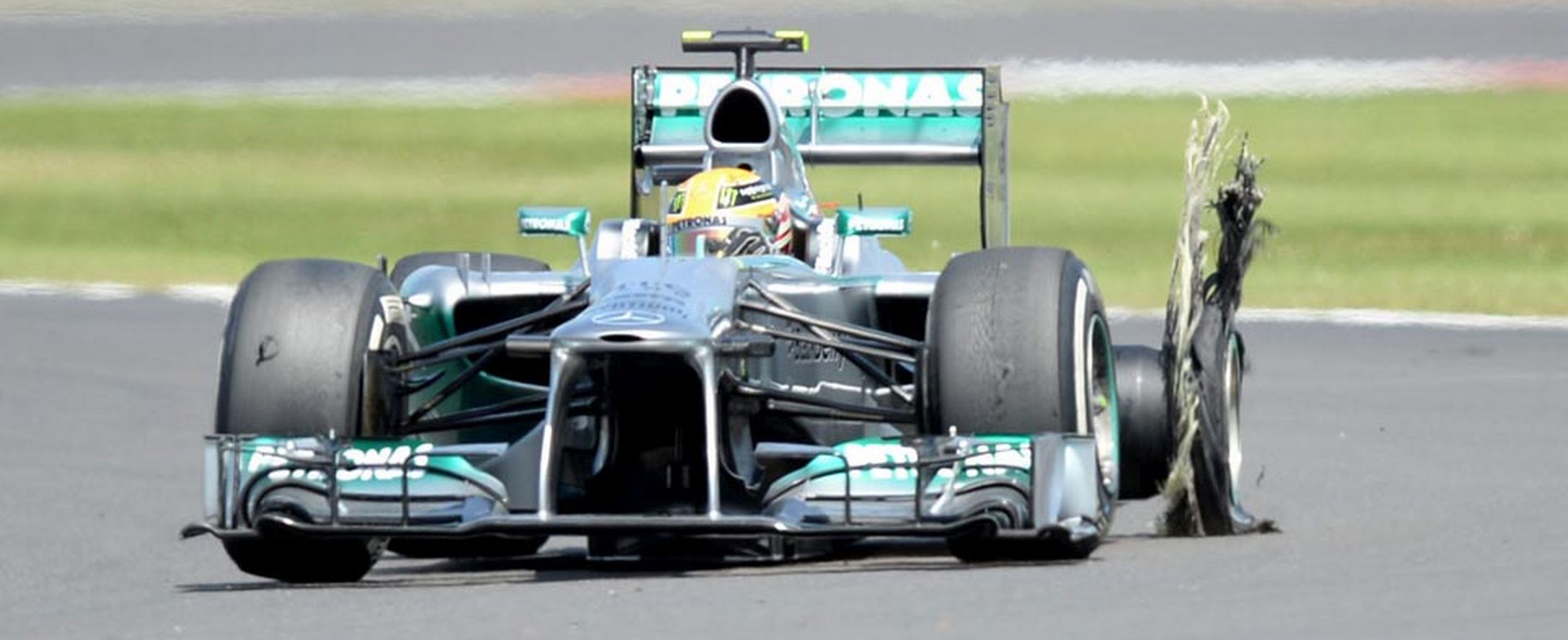
The latest hype is surrounding the dramatic failure of the tyres, made by global brand Pirelli. At the recent British GP a number of drivers were seriously compromised as their tyres spectacularly blew up.

Lewis-Hamilton-with-a-burst-tyreIn recent days, the whole sport has been pointing fingers it would seem. The drivers and teams are blaming Pirelli and calling on the FIA to take action. Pirelli, having undertaken a ‘forensic review’, have now blamed the teams for not following their guidance. Also under fire are the FIA for not having tighter regulations on tyre use. Finally, the Silverstone circuit has been blamed for not maintaining its corner kerbs to a high enough standard. The whole thing is a shambles!

The FIA it seems are the Architects of this situation as the root cause, as they wanted Pirelli to develop tyres which would degrade heavily. This is to help balance the racing field out more and to reduce the dominance of the leading players who continue to plow huge funds and technical solutions into winning races.

F1 racing is not so much ‘racing’ these days. The races and championships are lost and won through the teams strategists who continually seek an edge on every aspect of the race planning and technical development of the cars. The FIA have an ever increasing rule book of technical guidance designed to indirectly balance the field out. This isn’t working.

I think there is a simple solution to stop all this strategic and technical racing. Maintain the technical rules, provide tyres which are fit for purpose (!) and don’t compromise the racing or safety of the drivers, and introduce a Success Ballast requirement. Drivers leading the field, are required to carry success ballast, on a sliding scale in terms of weight vrs position. I have no doubt that the drivers/ teams would still try and act strategically if this were to be imposed, but its an entity which in theory cannot be manipulated and tweaked in any way to gain technical advantage again.

The FIA did consider this option around ten years ago, but it was felt that this would be too much of a direct influence on the racing. I think direct action, in a simple and hopefully effective way, would be better than the current situation. The sport is once again compromised, as I’m sure Pirelli are too! All this global coverage of their tyres blowing up cant be good for their brand and sales!

The British Touring Car Championship have been using success ballast for a while now click here to see how it works.

As a lifelong supporter of F1, my main interest is in seeing on-track racing action to determine who the best and fastest driver is. I’m not interested in pit-lane/ back-room strategy racing which is led by the biggest budgets and technical design solutions designed to push the limits (and beyond) of the regulations.

If teams budgets can’t be capped and the cars cant be identical, then success ballast surely seems a pragmatic way to encourage better on-track racing action?

The value of Apprenticeships

The last few years have been challenging in business; the most difficult years of my career to date. I started working in architecture back in 1996, so my work experience had been continual, positive growth up until 2008. At 33 I’ve been working for half of my life now! The next 5-10 years are I think as important as the previous 10 years, in terms of future direction.

One of my most important decisions was made (unknowingly at the time) when I started out at 16. I decided to leave school after my GCSE’s to undertake an Apprenticeship programme; to train to be an Architectural Technician. I joined Morrison Design Architects in Derby in June 1996 and spent a very happy and educational three years there. I gained a broad range of experience in terms of projects which included; Healthcare, Hotels, Leisure and Retail. I worked on the early strategic masterplanning work for the Royal Derby hospital, which is now fully complete some years later. I also worked on a number of large projects at the Belfry golf club in Sutton Coldfield. However for the first year, the majority of my time, as an office junior, was spent printing and folding drawings, and stenciling text onto tracing paper hand-drawn drawings (no CAD back then). This grass routes understanding of my profession set me up well  I think.

PrintIn January 2000 I joined a newly formed office at Lewis and Hickey in Nottingham. At the time we were only working on Boots projects, but over the following years we diversified our offer and grew as an office, and I grew with it. Today I’m the managing director of our Nottingham (and Manchester) offices – a position I am proud of, but more importantly; I recognise the weight of responsibility I now have to steer our offices and business into sustained growth.

People have said to me “how did you get to become a Board Director at such a young age?” The honest answer is “I don’t really know!” I don’t think I’ve done anything special or unique, my career progression has been organic. I am very driven by my work and I try hard to think creatively and strategically in all I do. My work experience exceeds my age in some ways, by that I mean; I should be in my early 40’s with what I have done to date. I believe I have had a lot of good luck and the good fortune to work alongside some great people over the years. I appear to have been in the right place at the right time so far. There has also been some hard graft in there too!

Key to my career progression has actually been my education route. To become a chartered architect, I have completed a HNC, two degrees and a diploma, all part-time while working four days a week. This is not an easy route to take! Evenings and weekends are hugely compromised, but the benefits are that you are working, developing your career, earning a salary and avoiding huge fee debts. Most importantly though, I have learnt my trade in a real working environment, where decisions and actions have consequences.

I recently attended a HAYS recruitment presentation and their view is that year out students and Graduates are increasingly sought after for recruitment in architectural companies now. There are probably a number of reasons for this. I think some of the stand out points are; Their fresh energy and motivation, which has not been influenced by the depths of recession, they can be very good in the latest software programmes we use, especially BIM, and of course they are at the lower end of the salary spectrum. Important in these continued lean times where fees are driven down. Clearly a healthy balance of staff experience is important.

Last year we employed a Part 1 student in our Manchester office for a years placement. Matt leaves us this week to return to Uni in September. He has been an excellent member of the team and has contributed a lot. The thing that has impressed me most about Matt is his drive to embrace as much technical experience as he can. He is a talented young man who has an eye (and hand) for design, but he recognises the importance of being able to understand how to ‘build’ buildings, in order to then be able to design them competently. I am confident Matt will do well in his career and I wish him the very best. I also hope we see back in the office in the future.

So whats my point in all this reflection about working/ studying? Well, I think young people today should be more receptive to part-time education, especially in Architecture. Apprenticeships/ Internships/ part-time study are a great way to learn and progress your career.

think-outside-the-boxAcademia is all well and good full-time, but it doesn’t teach you the real experience of worklife and designing/ building actual buildings. As an employer, the most important things I am looking for is relevant ‘work experience’, which is complemented by ‘education’. As young Architecture students now face a cost of over £100k to become chartered (fees, accommodation and living), surely part-time education will become a more favourable route to take? Otherwise Architects could be under threat of extinction in years to come – and then who knows what state our built environment would be in!

Part time Higher Education in Architecture is the future in my opinion.

The inside story at Bentley Motors

A couple of weeks ago I took two close contacts, one of which was fellow blogger Tim Garratt, for a private tour around the Bentley Motors factory in Crewe. I have been previously as my brother works there. When I left school I wanted to be a car designer or an architect. Clearly I went for the latter, but have loved cars for all of my life.

The Bentley factory is a very special place. Its was built in the 1930’s by Rolls Royce to manufacture the Merlin spitfire engine, they still have one on display in the factory. After the war, Rolls Royce and Bentley motors were made there. In 2002 VW Group had acquired Bentley (while BMW had purchased the Rolls Royce badge). This meant that VW had an amazing team of people who understood Bentley to the core; from the brand and design philosophy, to the exceptionally talented craftsmen and women. Today many of the staff working there have decades of experience, joined by a new generation of staff, who all share a genuine passion for Bentley and ensuring the very best quality in all they do. This is British manufacturing arguably at its best.

photo2a

Today, Bentley produce their flagship Mulsanne, the brand new Flying Spur, and the hugely successful Continental GT and GT Cabriolet. These cars are actually defined and differentiated by the amount of man-hours and detail involved in their production. They are priced accordingly too.

What is really clever though is the fusion of modern manufacturing with traditional coach building techniques. As you walk around the factory it is clear to see VW Group’s investment and experience has radically updated and improved the efficiency of building cars. However robots do not dominate, in fact there’s hardly any. People still hand-build these cars, with care and skill. This is one of the unique things that reinforces Bentley’s brand and exclusivity. There are many examples of the lengths that Bentley go to source the very best materials, there was one which stood out for me. For a Mulsanne car they use 17 full bull hides for each model! These Bulls are sourced from specific locations where they are not exposed to either barbed wire or insect bites. Bentley’s attention to detail, from source of materials to finish product, is second to none.

As you would expect, these cars are very customisable, in every conceivable way. Customers are taken into a Specification Lounge (equivalent to a first class airport lounge) where they are shown materials and examples of all the things they can choose to make their car ultra-unique. They have even matched a body colour to a customers nail varnish by painting a sample onto the salesmans hand in Dubai! He then flew back and ensured it was built to match. More money than sense perhaps? On the other hand, they get some customers making purchases by telephone by simply saying; “get me a blue GT please”. These cars start at around £115k! You can also purchase a wide range of branded accessories, from clothing to Breitling watches and even Bentley branded carbon fibre skis (for a cool £6000!)

The other aspect of the tour I was particularly interested in was the design process. There’s a great quote on the wall at Bentley which I thought I’d share;

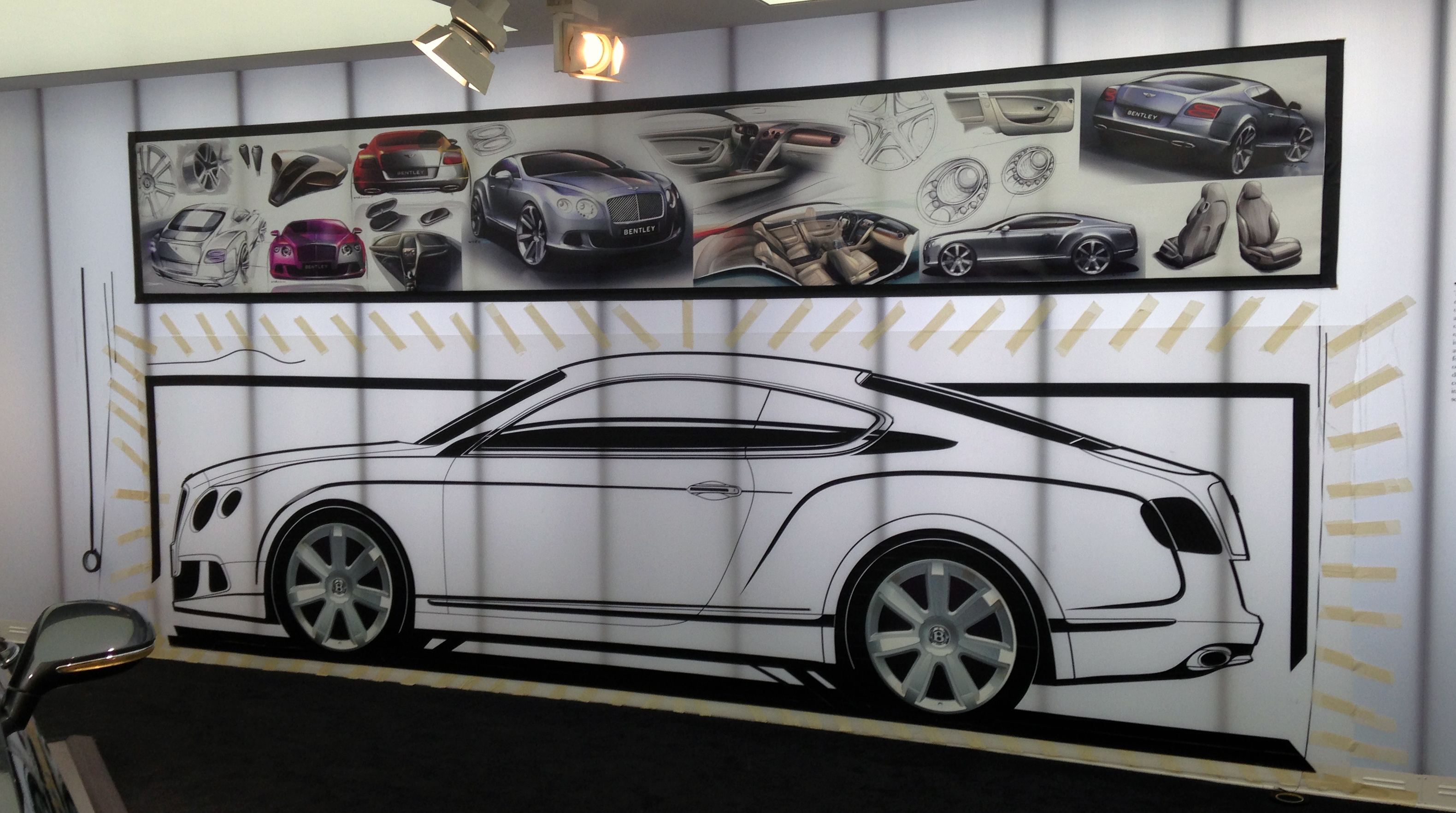
photoaEvery Bentley car in the world is designed and manufactured in Crewe. Their largest markets in recent years have been the Middle East and China. Clearly we didn’t go near the design studio, but we were informed about some of their methods. We saw a full scale clay model of a GT. Bentley adopt all sorts of processes to develop the cars design, including the NASA developed 3D printing which we are seeing in Architecture now. Their cars always start with hand-drawn conceptual sketches. Design should always begin with the pure connection of pen and paper, not constrained or influenced by any kind of technology. During the design evolution, Bentley have a ‘design garden’. This is an external space which is used to review and assess design development models in changing lighting natural conditions, either as the design team and/ or with the senior execs for key sign off stages.

What’s next for Bentley? Their uber luxury 4×4 is in development, set to exceed the Range Rover. They also hinted at a potential lightweight fast car – perhaps a competitor to McLaren road cars or of course Ferrari? They will no doubt be extremely careful to avoid becoming too mainstream and diluting their exclusivity, but they have a winning formula at the moment and it would be good to see Bentley evolve further with their luxury heritage.

So Bentley have successfully achieved a phenomenal transformation from being perceived to be a ‘poor mans Roller’, to now being a hugely successful independent brand in their own right – and its all made in Britain!

It was a fascinating experience and inspirational to see the dedication, passion and commitment of so many people in something they clearly love. Also to gain an insight into modern car design and manufacturing was interesting. I think I’ll be ordering a GT at some point in the future. Question is; what colour when the choice is limitless!

http://www.bentleymotors.com/

“Less is more” at the Yurt Farm

The famous German architect, Ludwig Mies van der Rohe, adopted the phrase “Less is more” to describe minimalist design during the Modern Movement of the early 1900’s. Today the phrase is still widely used, in many different contexts. This phrase was particularly pertinent to my last week, spent with my family in Wales on holiday.

We spent the week camping (well ‘glamping’ actually – glamorous camping) in West Wales, in a remote field called the Yurt Farm. Our objective was pretty simple; to get away. Properly away. The place was around eight miles inland from Aberaeron and was definitely remote. There was limited mobile signal and certainly no sign of 3G or WiFi! Its also completely off-grid in terms of electricity and gas. Perfect. There’s only one way to approach this sort of holiday; embrace it.

Yurt Farm1aThe Yurt Farm is simple living, but actually very well considered and crafted in lots of different ways. Its been carefully created by a local farming couple called Laurie and Thea (with their three young children). You leave your car at the gate and walk around 250m to your Yurt. There are a collection of wheel barrows to transport your stuff. These were also useful for shifting logs and our 3 year-old daughter! There were five Yurts in total, and a small converted train carriage as well!

A Yurt is a tent structure which is portable, but very strong and actually rather spacious. It originates from Central Asia and is still used widely in Mongolia for dwellings. They are cleverly designed. You can watch a great little video of one the Yurts on the farm being built here. Inside they have a wooden floor, a small wood burning fire, a double bed and a bunk bed (both hand crafted from local wood). This is called glamping, but actually this is proper camping! Apart from having a proper bed to sleep on, you live in a very simple and sustainable way. Heat is provided from burning logs (we got through plenty of them!), light is provided from a large circular window in the centre of the roof (and tea light candles at night). Outside we also had a fridge. This was a small wooden container with a deep cover of earth on top (which has herbs in), it worked!

It’s all really very liberating and feels authentic and natural. Quite the antithesis of my very urban life of frenetic movement around a largely man-made environment.

Living is equally as simple as the sleeping provisions. There is a communal kitchen/ lounge which is a beautifully crafted timber structure (a sort of rural Barcelona Pavilion – architect reference!) This has a big old Belfast sink with cold water provided from a local source. The Ty Nant spring water company is located just a mile or so away so this water hasn’t been through seven humans already! Hot water is provided, via solar thermal panels situated in the field, for both the sink and also two fantastic showers at the end of the building. The window/ vents in the showers are made of Ty Nant bottles – very clever. There are electric points for charging phones etc. These are powered by a small wind turbine and a solar electric panel in the field. Four on-site chickens roam freely in the day and provide fresh eggs. The farm also provide fresh organic fruit, vegetables and meat. There is also a great covered Al Fresco dining area which has a homemade Pizza oven! Finally the toilets; these are small carefully crafted wooden structures which (to my daughters amazement) didn’t have any flush! You simply ‘cover up’ with sawdust as you leave. Sound dodgy? These were really pleasant and didn’t smell. At nighttime they have solar powered fairy lights!

Yurt Farm2aThis is vernacular architecture arguably at its best; following nature and being very sustainable in many ways.

This was certainly a holiday with a difference. It’s not for everyone, and I’m sure some people get drawn in to the ‘idea’ of doing this, but would perhaps struggle with the reality. My advice is; go for it, embrace it for what it is and you will love it. Its a superb experience and one I strongly recommend, especially for families. We’ve got some great memories of our adventure, far more than you might get from a more conventional holiday.

For me, it was refreshing and exhilarating. It was also good to be a Human ‘being’, not a Human ‘doing’! It was great to escape for a while from urbanity, work and technology!

The Yurt Farm is great – visit their site here for more information.

Next Generation Student Living

I’ve just got back from London after attending the LD Events Student Housing Conference at the Congress Centre. I’ve been to this annual property conference for the last four years. This year however was slightly different as I was asked a few months ago to deliver a talk on ‘Design and Innovation‘ in the sector. This was a great opportunity for me and Lewis and Hickey to demonstrate our extensive experience and understanding of this impressive and mature asset class.

We have delivered over 11,000 bedrooms to date and have around 5000 bedrooms in development. These are pretty big numbers for us and it puts us in a small group of other Architects who have delivered this much.

P1Last night we had a great dinner with close colleagues from Jones Lang LaSalle, Savills, Interhospitality, HG Capital Investments, Balfour Beatty, Regal Property, Kaplan Colleges, Bouygues/ ULiving and Campus Living Villages. It was a good blend of people and backgrounds, with some informed and stimulating discussion on current opportunities in the sector.

The mood at the conference was pretty upbeat overall. The sector has been a bit ‘down’ following a perfect storm of challenges in 2012 which resulted in a reduction in student numbers and occupancy. For the sector this was a worry as suddenly national operators were reporting 85-90% occupancy when 98%+ had been the norm for a number of years. In the wider context, these dips were minimal, especially when you consider 100% asset voids in retail, industrial and office at present. Student Living is still attracting growing and significant investor interest with strong yields to be enjoyed.

The other big news, and recurring discussion today, was about Opal’s recent demise. I blogged about Opal a few weeks back (click here to see it). It was really good to hear both Bob Crompton and Charles Marshall reinforcing that Opal is/ was a strong and well respected business, and that their assets have never been distressed. Their problem was around their funding model and there was a genuine disappointment that Opal have paid the ultimate price. The impact of Opal seems to be strengthening the sector, rather than compromising it as some people were concerned about. Their operator brand strength though has suffered because of all the media coverage. As a result; Universities, Parents and Students will probably avoid Opal accommodation this coming year. This is unnecessary, but people will have their view on this. It was also good to see so many (ex)Opal people at the conference, all still working in the sector in different ways.

In my talk I focused on Branding and “student experience”, the evolution of interior design ideas/ products and the progression of design quality in the architecture. Student Living design has changed significantly in recent years and I believe we are now firmly in a second generation of design/ product.

Following my talk, I was a little overwhelmed by how many people acknowledged and thanked me for my summary. I didn’t anticipate this and I was humbled by the kind words. A couple of people have asked me for a copy of the presentation so I thought I’d post a link to it on here.

CLICK HERE TO VIEW MY PRESENTATION (it’s 7mb and in PDF format).

It was good to see so many close contacts at the conference, the sector has a real property ‘community’ and I feel privileged to be part of it, both personally and of course for my business Lewis and Hickey Architects.

In conclusion; it was a great event to be part of, and of course even better to meet many established contacts and also make some new ones. If you are looking at Student Living development and need some advice, or want to explore some design ideas, please don’t hesitate to get in contact with us. Some of our recent projects can be seen here.

You can also contact me directly by email nick.riley@lewishickey.com, I’d be delighted to talk to you.

Lego. Six decades and Building

My three year old daughter has recently discovered Lego. I remembered I had an old box of it in the loft and she loves playing with it now. I loved Lego; it may well have been an early influence in my career as an Architect. The principle of Lego, in relation to architecture, bears many similarities – especially today, where we are increasingly constrained by standardised components. I have also recently been reminded just how painful it is to stand on one of those minute pieces of Acrylonitrile Butadiene Styrene!

Lego has an impressive history – especially for a toy; which more commonly tend to come and go with children’s trends. It was founded, and is still manufactured, in Billund Denmark. Its roots go back to wooden toys built in the late 1800’s, but the plastic Lego bricks we know today have been around since the late 1940’s. “Lego” comes from the Danish phrase leg godt, meaning “play well”.

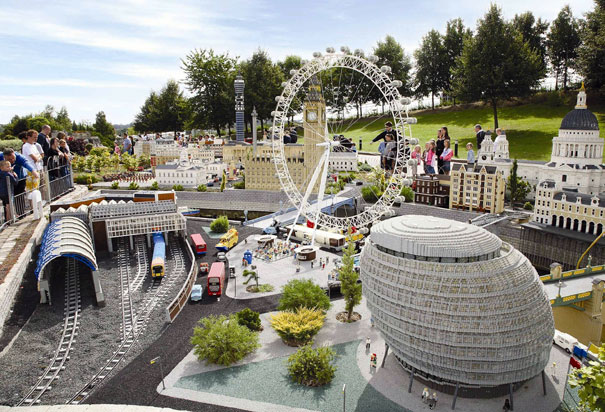
Legoland LondonThere is a Legoland theme park in Windsor, but I didn’t realise that there are two more in America, one in Germany, one in Malaysia and, of course, one in Billund. Windsor also has a Lego Hotel. In theory this surely has the potential to be an amazing building, but the reality is a real disappointment – imagine a Travelodge with a Lego clad entrance.

Lego remains a huge and diverse company. The limitless range of different assemblies ensures it can keep producing new ideas. It’s a globally recognised brand and turned over £2.65bn in 2012. It’s probably reasonable to assume that most people in the UK have owned/ played with it at some point. Lego believe that they have produced some 600 billion Lego elements to date.They currently produce approximately 36 billion elements per year. If all the Lego bricks ever produced were divided equally among the world population, each person would have 62 Lego bricks! Its also been said that Lego produces the most tyres in the world – small ones of course! They produce 318 million tyres a year, nearly half of all Lego sets feature tyres on them.

Lego Volvo XC90There have been many one-off constructions using Lego, these include; a full sized Volvo XC90 car and several towers, one reaching 32m high (around 9-10 storeys!) and utilising 500,000 bricks. In 2009 James May built a Lego house – as in a full size one. It was an impressive achievement, but not a great looking dwelling – hence why it was later demolished.

Lego people (or miniFigures as they are called) have become very popular in their own right. Last year, while at the Olympics, I saw a superb cutaway model of the Olympic stadium using 100,000 bricks, all the seats were then filled with 10,000 individual Lego people. Impressive!

Lego Olympic StadiumIn 2010 Lego launched a new sub-brand (I’m amazed they haven’t done is sooner). It’s called ‘Lego Architecture’. These are models of famous buildings/ landmarks from around the globe. There are eighteen models in the series now which includes; The Empire State Building, Solomon Guggenheim Museum, The Sydney Opera House,  The Burj Khalifa and Big Ben. My favourite is probably Le Corbusier’s Villa Savoye house in Poissy on the outskirts of Paris. Take a look at the Lego Architecture collection, click here.

So Lego has enjoyed six decades of building. Its an impressive story. I hope Lego has many more years of evolving and will continue to inspire children with simple, creative and imaginative play.

Nottingham can’t see the wood for the trees…

I have worked for Lewis and Hickey Architects in Nottingham for over 13 years now. I like Nottingham a lot (even though I grew up in Derby and still live there now). In my early years working in the city I always perceived Nottingham to be ambitious and leading – especially as it’s the largest ‘urban area’ in the East Midlands (Leicester is the largest city). However in recent years I think it’s lost its way a bit, and this view seems to be shared by a growing number of fellow property professionals I talk to. I’m now the managing director of our Nottingham office and therefore have a very strong interest in the city’s economic growth and property investment/ development.

monopoly_NottinghamWhen you consider what Nottingham is ‘famous’ for, there are many positive things, but how relevant are these today in terms of promoting the City?

  • Robin Hood and Sherwood Forest
  • Nottingham Castle and the Caves
  • Its Retail offer (?)
  • Two Universities
  • The Industrial Revolution and Lace Making
  • Bicycles (Raleigh cycles)
  • Tobacco manufacturing
  • Boots the Chemist
  • Trent Bridge Cricket
  • Torvill and Dean (and the national Ice Centre)
  • Goose Fair
  • A football club (with a sorry looking stadium)

Attracting people to Nottingham is very important on many levels, not least of which to promote inward investment for our economy and employment. Of the brief list I’ve stated above, I don’t believe many of those headings are properly celebrated in terms of the city’s offer. A couple of exceptions would be the two Universities and Trent Bridge Cricket Ground who all work hard to progress and support the city in different ways. In fact the University of Nottingham’s Jubilee campus continues to expand (on the old Raleigh cycles manufacturing site) and is a showcase for contemporary learning facilities and architecture (including our Si Yuan New China building). Nottingham’s 60,000 strong student population brings diverse and significant economic benefits to the city – from all over the world! Is this properly recognised?

It’s very easy to come to Nottingham and not really get any sense of Robin Hood or the Castle/ Caves – is this a good thing or a bad thing?

Nottingham’s major manufacturing focuses on Medicines, Cosmetics and Tobacco. Other big employers include Experian, Capital One and E.ON UK. The largest employers are public sector based – this can’t be sustainable?

Compare the above with neighbouring Derby who have a strong focus on “Planes, Trains and Automobiles” through manufacturing at Rolls Royce, Bombardier and Toyota. Derby is looking to lead innovation in these areas as part of their economic sustainability strategy, working in partnership with these companies and others.

Nottingham’s retail offer remains a historic thing I think. With both Derby and Leicester offering newer retail centres, the continued need for the Broadmarsh development to happen is hugely important and it needs to be impactful.

One positive thing that is emerging from the City is the Local Enterprise Zone, called D2N2 (“The postcode to be at” according to Peter Richardson, the recently appointed Chairman of the LEP who I met recently). It will be located on the edge of the Boots site, to the south of the City. My concern with this is whether Boots might then further diminish its presence in Nottingham under its new American ownership perhaps? I genuinely hope that D2N2 does generate some positive progress for the City and, importantly, that is can be realised. Another ‘Eastside’ or ‘Broadmarsh’ that have largely failed to materialise to date would be disappointing.

Another good thing for the economy is the current Infrastructure investment. This includes the NET tram expansion and the long overdue A453 dual carriageway. Super fast broadband is also a must. Connectivity, both physical and digital, is fundamental. But you have to want/ need to go there.

I know all this sounds quite negative and I guess it is on the face of it. However, my point here is that Nottingham needs to move forward and I’m not so sure it is . It needs strong leadership and vision that will maximise promoting investment into the city. If I don’t really understand what Nottingham is about, then how are people who don’t know the city meant to understand?

I think the future focus/ differentiators that should make Nottingham stand out are;

  • The Universities (and their student population)
  • Promoting a stronger cultural message (More Arts and Museums; especially Robin Hood and the Castle). Create a new leisure destination – to complement a new retail destination!
  • Provide a stronger message as to why major employers should consider investing in Nottingham.

I will continue to support Nottingham in any way I can, I genuinely want it to positively address these concerns – that’s why I’m writing about it. However watching other regional cities move forward, whilst Nottingham lacks a clear message, will not provide a sustainable economic future.